Edison’s death
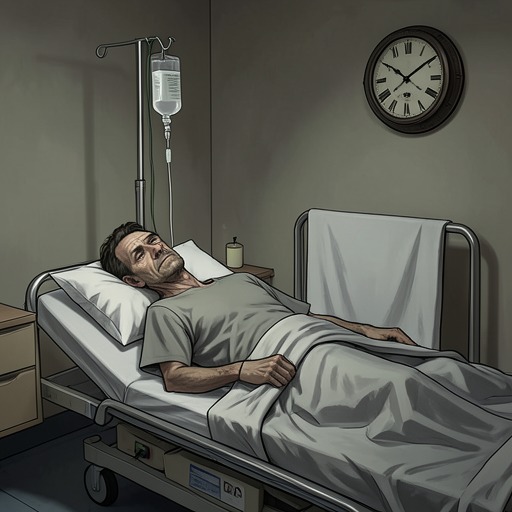
Big BrotherEdison’s death at forty-nine leaves his sister with no settled explanation for what happened to him and no clear boundary around what she owed him. In retrospect, she reassembles his decline alongside the vivid, imagined alternative of their shared life in Iowa: a diet, music, exercise, and a triumphant weigh-in. The contrast makes the loss more than an ending; it turns into an enduring reckoning with the limits of care, the force of discouragement, and the hunger that neither food nor success could satisfy.
The Question Left Open
The story does not offer a single cause for Edison’s deterioration. When Fletcher asks what happened to him, his sister cannot answer; it will take her months even to formulate a response. Later, she identifies the chicken-and-egg question she could not resolve: was Edison fat because he was depressed, or depressed because he was fat? His sister’s account preserves that uncertainty rather than treating weight as a complete explanation of his life.
The difficulty is compounded by the way other people read his body. She recalls the looks Edison received in public, especially in the supermarket, where his loaded cart seemed to draw a collective eye-roll. Cody’s kindness gives him comfort, but Fletcher worries that Edison is using up her goodwill. The family’s competing concerns—sympathy for his suffering, fear for his health, and anxiety about the people caring for him—remain unresolved when his sister tries to understand his death.
The Life Imagined Afterward
After Edison’s death, his sister repeatedly returns to a parallel life that never came to pass. In it, he joins her in Iowa, attends a Ketosis Party, accepts a rented piano, and explores music from West Side Story to Lyle Lovett. The imagined scenes also include hiking, biking, sandbagging, and the return of his cheekbones to the sunlight. Their discipline has comic edges: they recite a fractured oath against the flab of American waists, then watch Edison step onto the scale before people who have grown to love him. He weighs 161 pounds.
That sequence is not presented as a factual recovery or as proof that the plan would have cured him. It is a counterfactual life whose details are made more painful by their specificity. Its ending—a public weigh-in and the affection of witnesses—offers a version of belonging and achievement that the actual story cannot secure. The imagined transformation therefore marks both what his sister hoped for and what she can no longer know.
Music, Memory, and Reduction
His sister’s later attention to Edison’s CDs changes what she believes should survive of him. Listening with the concentration she might have given the recordings when they were new, she concludes that he was a fine musician. His paternal shortcomings remain part of her judgment, but she resists allowing his size to eclipse his work. To remember him chiefly as fat would, in her view, be a travesty.
This recovery of his music stands against the story’s repeated attention to food and weight. The body that attracts public judgment is not the whole person; neither does the musical achievement erase the difficulties of his life. His sister’s remembrance holds both realities together, insisting that Edison be understood as a musician and family member as well as a man whose decline was bound up with overeating, discouragement, and unmet needs.
Responsibility Without Measure
Edison’s death sharpens his sister’s question about the obligations of kinship. She concludes that a person cannot calculate a blood relative’s claim by setting a fixed term on help: once she became her brother’s keeper, she could not simply have chosen three months of assistance rather than four. Her language of unlimited responsibility does not make the choice easy or settle what assistance could have accomplished. It exposes how care can become impossible to delimit even when its outcome is uncertain.
She had found it simpler to tell herself she bore no responsibility for Edison than to work through that emotional arithmetic. After his death, that evasion has a cost: she says she pays every day. The declaration gives the ending its shape. There is no final answer to what happened to him, or to whether a different decision would have changed his life; there is instead a continuing reckoning in which regret and love persist beyond the chance to act.